Lost a Pandora bracelet at the beach? Why silver is harder
A lost Pandora bracelet is a harder search than a ring. Here is how a silver chain and loose charms read on a metal detector, and what helps find them.
A lost Pandora bracelet can be found with a metal detector, but it is usually a harder search than a ring. The silver itself is easy to detect. The trouble is that a bracelet is a thin chain with charms hanging off it, and when it comes off in the sea it often does not stay in one piece.
We get these messages more often than people might expect. A bracelet slips over a wet hand while swimming, or the clasp opens while someone is lying on a towel, and it is only missed later at the hotel. What follows explains why these searches are different, and what you can do in the first few hours to give one a fair chance.
Why a silver chain reads weakly
Most Pandora bracelets are sterling silver, and silver is a very good conductor. A solid silver ring or an old silver coin gives a detector a clear, strong signal. So it surprises people when we say a silver bracelet is one of the harder things to find.
The reason is the shape. A detector reacts best to a solid piece of metal, ideally a closed loop like a ring. A snake chain or a link bracelet is made of many tiny pieces joined together, and to the coil it behaves more like a scattering of small targets than one solid object. Lying flat in the sand, a bracelet can give a faint, broken signal that is easy to mistake for a ring pull or a bit of foil.
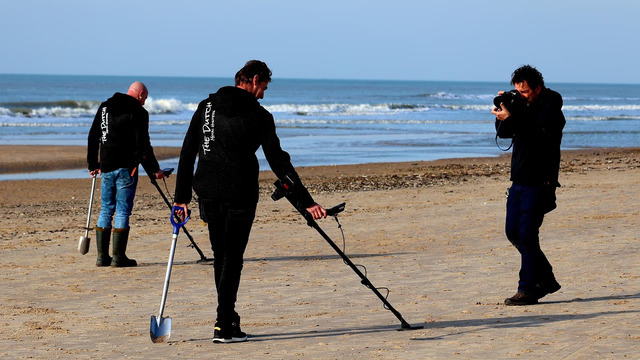
Wet salt sand makes this worse. Salt water is itself conductive, so on the wet part of a beach and in the shallows the detector has to work through that background. A thick gold band still stands out. A light silver chain at 10 to 20 cm in wet sand is close to the limit of what many machines will pick up cleanly. Our local detectorist will usually slow right down and work tighter lines when we know the target is a bracelet.
Then there are the charms. Each charm is a small solid lump of silver, which on its own reads better than the chain. But many Pandora charms have glass or enamel on the outside, and some bracelets are leather or fabric with only a silver clasp. If yours is one of those, tell us, because it changes what the detector is looking for.
Silver also tarnishes quickly in salt water and turns a dull grey. A bracelet that would catch the eye on a beach towel can sit on the surface of wet sand and be almost invisible. That is why a search for a bracelet is partly by detector and partly by eye.
When the charms come apart
If the bracelet came off whole, it tends to stay together. If the clasp broke or the chain snapped, the charms can slide off the end and spread out. In the surf they move separately, and a heavy charm can end up some distance from the chain it came from.
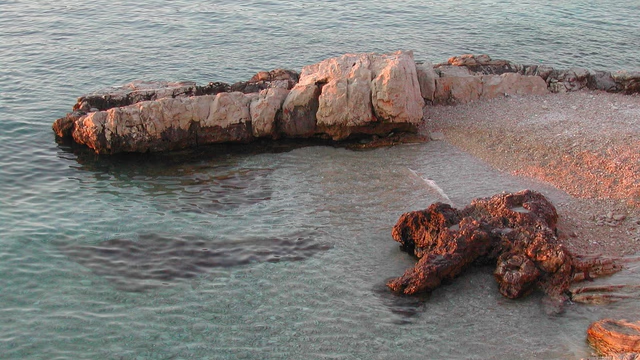
On a sandy beach like those around Ibiza and Formentera, loose charms tend to drop into the softer sand where the waves break and get buried with everything else that sinks there. On the pebble and shingle beaches along the Albanian coast at Ksamil and Sarandë, or on the pebble town beaches in Croatia, they can slip down between the stones, sometimes deep enough that the detector hears them but they have to be dug out by hand.
This matters for how a search is planned. For a ring we are looking for one target. For a broken bracelet we may be looking for the chain and several charms, and finding one piece does not mean the job is done. Many owners care most about one particular charm, a gift or something with a date on it. If that is you, tell us which one, and describe it as clearly as you can.
It also helps to know which bracelet it is. A snake chain and a bangle behave very differently in the sand. A bangle is a closed loop and often reads far better than a chain. A photo of the bracelet on your wrist, even a holiday picture with it in the background, helps our finder know what to expect.
What to do if you have just lost one
Start the same way you would for a lost ring. Look carefully at the surface first, in good light, along the line where you were sitting or swimming. Check your towel, your bag and the sand right under where you lay before going any wider. Clasps open quietly, and a lot of bracelets are found within a few metres of the towel.
If it went in the water, try to remember roughly how deep you were standing and which way the waves were coming in. Take a photo from where you were, with something fixed in the background like a beach bar or a lifeguard tower. Do not dig around wildly in the wet sand yourself. Digging moves things around and can push a light chain deeper.
Do not post the exact spot on social media. We wrote about why in our piece on not posting where you lost something. A silver bracelet with charms is easy to describe and easy for someone else to pick up and keep.
Report it to the hotel or beach club, and to the local lost property office or police. Keep one detail back, such as which charm is on which side of the clasp, so you can prove it is yours if it is handed in.
Time matters more for bracelets than for rings. Because a chain reads weakly to begin with, every tide that covers it with more sand makes it harder to hear. A search in the first day or two has a noticeably better chance than one a week later. We cannot promise any search will find it, and on a busy beach with strong waves a thin silver chain may be gone for good. But a clear spot and a quick start make a real difference.
If you would like one of our local detectorists to look for it, send us the details through the get help form or on WhatsApp. Tell us where it happened and which charms were on the bracelet. We will give you an honest view of the chances and explain the costs before any search is booked.