Why Rings Slip Off in Cold Water — and Who It Happens To
Cold water shrinks your fingers by a surprising amount. Here is the physiology behind the most common way wedding rings are lost, and how to avoid it.
Almost every ring we recover from water was lost the same way, and it is rarely carelessness. It is vasoconstriction — a completely involuntary response that makes your fingers measurably thinner within minutes of entering cold water.
If you have ever come out of the sea and noticed your ring spinning loose on your finger, you have felt it happen. Most people never connect that sensation to the risk.
What your body is actually doing
When skin meets cold water, the body starts protecting your core temperature. Blood vessels in the extremities narrow, pulling warm blood away from hands and feet and back toward the trunk. Less blood in the finger means less volume, and less volume means a thinner finger.
The effect is not subtle. Finger circumference commonly drops by around half a ring size in cold water, and can reach a full size in genuinely cold conditions — a British sea in May, an Alpine lake, a hotel pool that has not seen sun all morning.
Half a ring size is more than enough. A ring that has fitted perfectly for a decade becomes a ring that will come off if you flick your hand.
Ten minutes in cool water is enough to change how a ring fits.
Why it usually happens on the way out, not in
This is the pattern that surprises people. The loss almost never happens while swimming — it happens during a sharp hand movement after the fingers have already cooled.
The common ones:
- Towelling off. A brisk rub down the arms is exactly the motion that strips a loose ring.
- Throwing something. A ball to a child, a frisbee, a handful of water.
- Shaking water off your hands. The single most common one we hear.
- Pulling on a wetsuit or a rash vest. Rings catch on neoprene and get levered off.
- Applying sun cream. Slippery hands plus a loose ring.
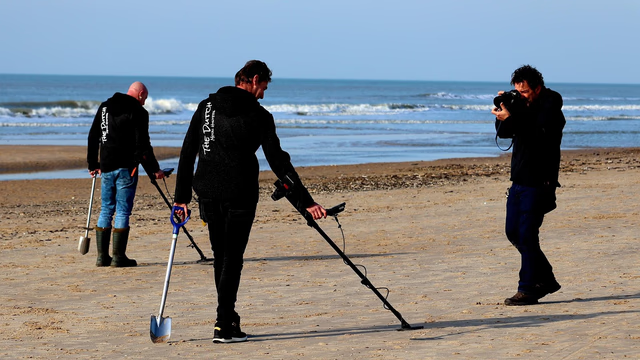
Notice that most of these happen in shallow water or on the sand at the water’s edge. That is genuinely good news for recovery: the search zone is the wet band and the first few metres of water, not the open sea.
Who it happens to most
Some patterns show up over and over:
People who have recently lost weight. A ring sized to a heavier hand plus cold water is the highest-risk combination there is.
Anyone on holiday in a cooler sea than they are used to. Northern European water in early summer catches out visitors constantly. The air is warm, so nobody thinks of the sea as cold.
Men with plain bands. A smooth band has nothing to catch on the knuckle. A ring with stones or an irregular profile is far more likely to snag and stay on.
New wedding rings. Newly married couples are on holiday, in the water, and wearing a ring their hand has not adapted to yet. It is by some distance our most common recovery.
Cold-water swimmers. The people most exposed to the effect are often the least surprised by it — but a ring is still a ring.
What actually prevents it
The advice that works is boring, and it is all about the thirty seconds before you go in.
- Take it off before you go near water, and put it somewhere that is not a pocket. Pockets turn out to be a leading cause of loss on their own. A zipped bag compartment, or better, the hotel safe.
- If you will not take it off, wear a silicone band instead for the trip. They cost almost nothing and are the single most effective thing we can recommend.
- Get the fit checked if you have lost weight, or if the ring spins freely when your hands are warm. A jeweller can size it down or fit sizing beads.
- Be deliberate after swimming. If you kept the ring on, dry your hands slowly and keep them low. Do not shake, do not throw, do not towel briskly until the ring is off or your hands have warmed.
If it has already happened
The physiology that causes the loss also constrains where the ring ends up, and that works in your favour. Fingers cool in shallow water, and the movements that strip a ring happen in shallow water. So the ring is usually within a small, well-defined area near the waterline — not out in the depths where people imagine it.
Mark the spot, note the state of the tide, and get a detectorist there before the next few tide cycles rework the sand. Water recoveries have some of the best odds of any search we run, precisely because the physics puts a narrow boundary on where the ring can be.