
Austin and its lakes
Lost a ring in Austin or Lake Travis?
Swim coves west of the city, river parks along the water, and lawns and gardens everywhere in between
A chain goes without a sound: over your head with a wet shirt at a swim cove, or off a neck at a picnic table. A lake has no surf to carry it along, so in the shallow margin it drops almost straight down and stays near where you stood.
Ring Seekers is a lost ring and jewelry recovery service that works with experienced local metal detectorists to search for a ring, wedding band, watch or phone lost in Austin and on its lakes in Central Texas.
The search is done by an experienced detectorist who knows the area. We look for a detectorist who can reach the water or the lawn you lost it on, brief them with your map and photos, and say plainly when the chances are low. This page is for a lost ring or a wedding band, and just as much for a chain, an earring, an Oura ring, a watch, keys or a phone.
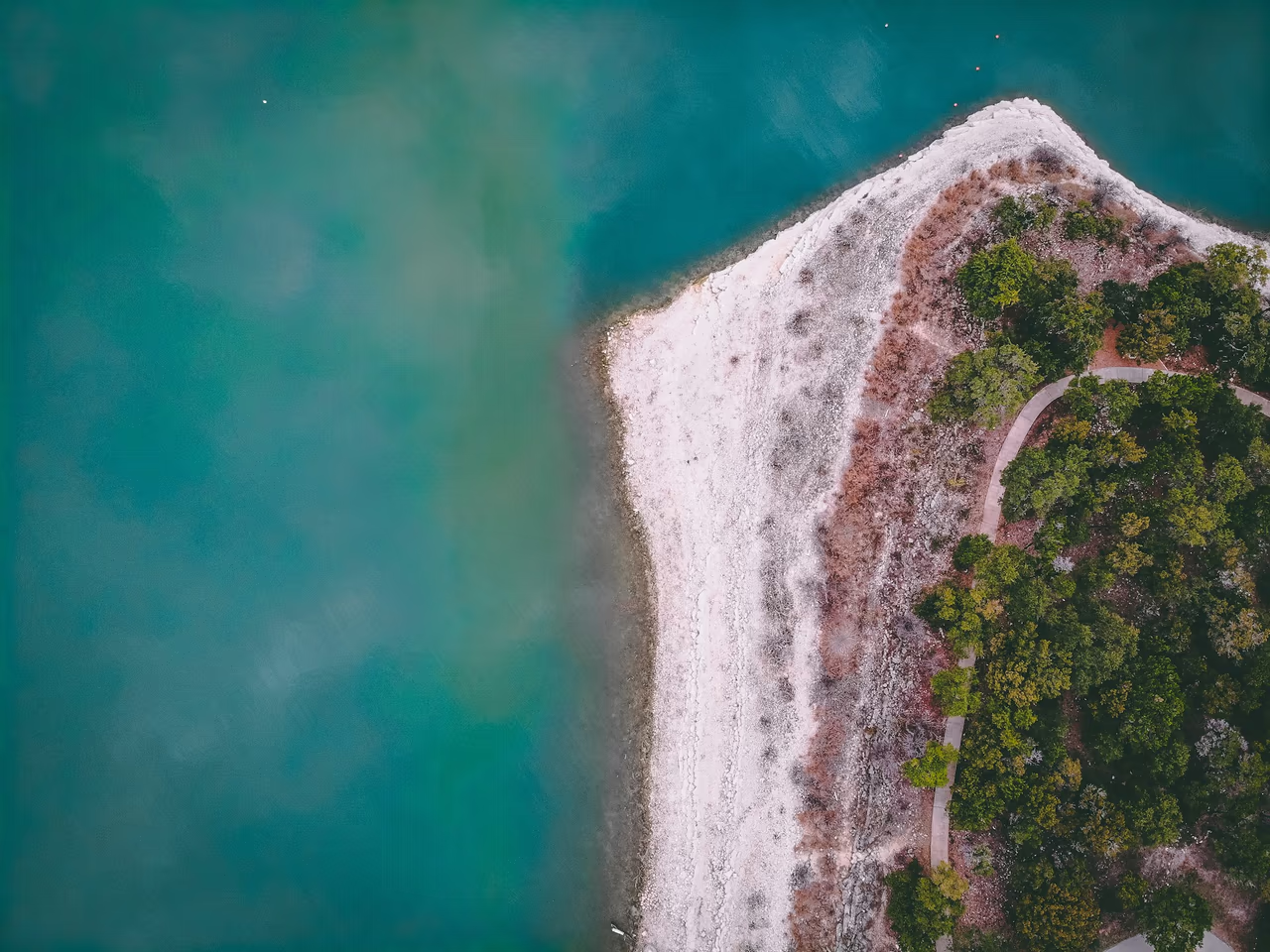
The first hour, at a lake edge or on a lawn
Stop walking over the area. Take a photo from where you stood with something fixed in the frame, such as a boat ramp sign, a pavilion or the Boardwalk rail. Drop a pin on your phone. At a lake, note the time and where the water line was. At home, keep the mower off that part of the lawn.
Then send us the pin, the photos and what came off, with the details a detectorist uses. In the water, how deep you stood and what you lined up with on shore. On grass, whether it has been mown or raked since. If there is a park office nearby, ask there first, because jewelry is often handed in.
Places we cover in Austin and its lakes
- Austin
- Lake Travis
- Hippie Hollow Park
- Pace Bend Park, Spicewood
- Mansfield Dam Park
- Lady Bird Lake (Town Lake)
- Ann and Roy Butler Hike and Bike Trail and Boardwalk
- Zilker Park
- Barton Springs
- Lake Austin and Emma Long Metropolitan Park
- Walter E. Long Lake and Metropolitan Park
- McKinney Falls State Park
- Back gardens, lawns and sports fields across Austin
Where chains, rings and jewelry go missing around Austin
Big lakes to the west, city parks along the river, gardens everywhere.
Hippie Hollow Park, Lake Travis
Hippie Hollow covers 109 acres (44 hectares) on Lake Travis, about 30 minutes from downtown, with a steep, rocky shoreline and a swimming area with no lifeguards. A chain lost here means a slow search among rocks, not a clean sweep of sand.
Pace Bend Park and Mansfield Dam Park
Pace Bend Park near Spicewood covers 1,368 acres (554 hectares) with more than nine miles (14 km) of Lake Travis shoreline, and swim areas at Mudd Cove, Kate's Cove and Gracy Cove. Mansfield Dam Park is 71 acres (29 hectares) beside the dam, with a four lane boat ramp, a swim cove and an underwater dive park. Name the cove you swam from.
Lady Bird Lake and the Hike and Bike Trail
The Ann and Roy Butler Hike and Bike Trail runs about 10 miles (16 km) around Lady Bird Lake, including a 7,250 foot (2.2 km) Boardwalk over the water on the south shore. On a loop like that, where you stopped or turned round is worth more than the name of the trail. Anything that falls into the lake is much harder.
Zilker Park and Barton Springs
Zilker Metropolitan Park covers more than 350 acres (140 hectares) where Barton Creek meets Lady Bird Lake, with 5 volleyball courts, and hosts the Austin City Limits Music Festival, so a chain can go on its grass in a crowd. Barton Springs Pool sits inside it, 3 acres of spring water at 68 to 70°F (20 to 21°C).
Lake Austin and Emma Long Metropolitan Park
Lake Austin covers 1,830 acres (741 hectares) and is 20.25 miles (32.6 km) long but only 1,300 feet (about 400 metres) across at its widest. Emma Long Metropolitan Park sits on its shore, with a designated beach entry swimming area, shallow and narrow enough to make a wading loss one of the better cases.
Walter E. Long Lake, east Austin
Walter E. Long Metropolitan Park at 6614 Blue Bluff Road is the largest city park at 2,480 acres (1,004 hectares), around a 1,200 acre (486 hectare) lake. Its two sand volleyball courts are far kinder to a searcher than turf, so name the court.
Gardens and sports fields across Austin
A lot of what we are asked about around Austin is a back garden, a school field or a wedding venue lawn. On mown grass a chain settles into the thatch, where the eye goes straight past it and a detector does not.
How Ring Seekers handles an Austin loss
One person on WhatsApp
The same person reads your first WhatsApp message and stays with you until the search is done or ruled out.
Your map goes to the detectorist
Your pinned map and photos reach the detectorist before the search day, so nobody starts from a vague description.
Plain words when the odds are poor
A phone dropped from a boat far out on Lake Travis is not a detectorist job, and we say so.
Still water and mown grass are opposite problems
On a lake nothing rolls a chain along, so it stays near where it went in. On a lawn the opposite is true: it is inches from the surface and nobody can see it. The detectorist is told which to expect.
The cost arrives with the honest answer
What a search would cost comes in the same message as our read on the case, and nothing is arranged until you answer it.
Ground, water and lake levels around Austin
Austin has no tide. The height of Lake Travis and the kind of ground count for more.
Lawns, rock and sand
On a lawn a ring usually sits in the grass thatch or the top few centimetres of soil, a depth any detector reaches. Rocky Lake Travis shores are the hardest ground.
Lake Travis rises and falls, Lake Austin barely moves
LCRA counts Lake Travis as full at 681 feet above mean sea level, but it has been as low as 614.18 feet in August 1951 and as high as 710.44 feet in December 1991, a swing of almost 100 feet (30 metres), so the shoreline you stood on can move a long way. Lake Austin normally runs between 491.8 and 492.8 feet, about 1 foot (30 cm) of change, though it is lowered for planned drawdowns, such as the one set for 12 October to 30 November 2026. A detectorist works the shallow margin where standing is safe, and anything further out is diving work.
Cold spring water at Barton Springs
Barton Springs Pool holds 3 acres of spring water at 68 to 70°F (20 to 21°C) all year. Cold water shrinks fingers, which is when a band slides off without being felt, and it is why so many losses happen on the way in rather than mid swim.
Volleyball sand and open lawn
Loose sand gives up a signal more readily than turf, and there are 5 volleyball courts at Zilker and two at Walter E. Long. Open lawn is slower work, because grass holds a small target close to the surface and hides it completely.
Want a first idea of your chances? Try the lost ring recovery calculator.
If it happened at a cove, on the trail or on your own lawn
My chain came off swimming at Pace Bend. Can it still be found?
It can, once you name the cove. Pace Bend covers 1,368 acres (554 hectares) with more than nine miles (14 km) of Lake Travis shoreline, and the swim areas are at Mudd Cove, Kate's Cove and Gracy Cove. A lake has no surf to roll a chain along, so it drops almost straight down. Tell us the cove, how deep you stood and what you lined up with on shore.
My wedding band came off at Hippie Hollow. How hard is that ground?
Harder than most. Hippie Hollow covers 109 acres (44 hectares) about 30 minutes from downtown, and its shoreline is steep and rocky rather than sandy, so a band can drop between rocks instead of settling in one layer. The search is slow and close, which makes the few feet you can point to worth more than anything else you tell us.
I dropped my phone off a paddleboard on Lady Bird Lake. Is it worth trying?
It is a long shot, and you would hear that from us first. Parts of the lake drop quickly from 2 or 3 feet (under 1 metre) to far deeper water, and a detectorist works the shallow margin where standing is safe. Tell us how far off the bank you were and which part of the Boardwalk you set off from.
I lost an Oura ring at the Emma Long Park beach on Lake Austin. What now?
Start with the water line. Lake Austin is normally held within about a foot of full, so the line you remember is usually close to today's, unless the lake has been lowered for a planned drawdown. Emma Long has a designated beach entry, so tell us how far along it you were and how deep you waded. An Oura ring is titanium and gives a weaker signal than gold.
Can an earring lost on the volleyball sand at Walter E. Long be found?
Often, yes. An earring is a small target, but loose sand gives up a signal far more easily than turf, and the park has only two sand volleyball courts. Walter E. Long is the largest city park at 2,480 acres (1,004 hectares), and naming the court turns all of that into one square of sand.
I lost my wedding ring in the garden at home in Austin. Is that worth a search?
Often it is the best case of all. A ring or a watch dropped on a lawn usually sits in the grass thatch or the top few centimetres of soil, a depth any detector reaches. Leave that patch unmown and unraked, because mowing and raking carry things a long way, and send us a rough drawing of the garden with your route across it.
What do you need from me to start?
The lake or the park, the spot within it, the day and time, and a photo of the chain, ring or watch. Say whether it went into water or onto ground, and how deep you stood. We come back with how the case looks and what a search would cost, and nothing is arranged until you say yes.
Austin and its lakes
Say which cove, which lawn, and how deep you were
A pin, a photo and the time are the whole message.
A lake does not wash things along the way surf does, so a spot you can name today is still worth searching tomorrow. Send the photo and the pin on WhatsApp, and you will hear how the case looks before anything is arranged.