Lost a ring at the beach? Do not post the exact spot online
Posting the exact spot where you lost a ring tells anyone with a metal detector where to look. What to share publicly, and what to keep back.
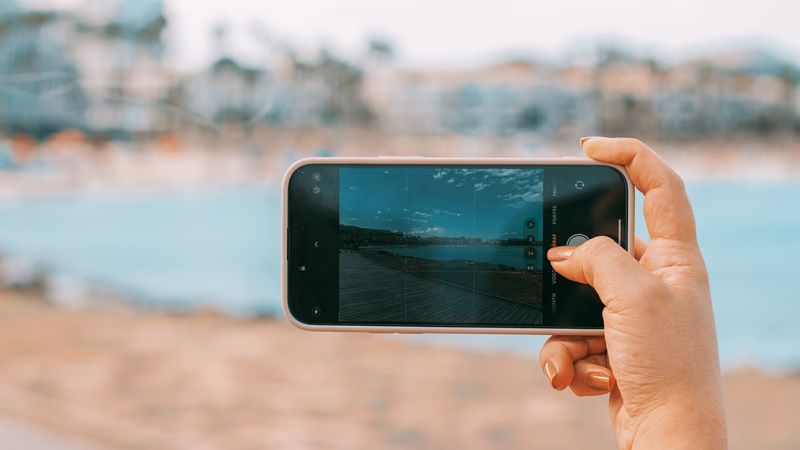
When a ring goes missing on a beach, the first thing many people do is reach for their phone and post about it. A local Facebook group, or a holiday page on social media. Something like “Lost my wedding ring at the main beach this afternoon, by the third lifeguard tower, about ten metres from the water.” It feels like the sensible thing to do. More eyes, more chance.
The trouble is who else reads it. Plenty of people own a metal detector, and a post with an exact spot in it works like a map. Someone can read it in the evening, walk down at first light and be standing on that patch of sand before you have had breakfast. Most people are honest and would hand a ring back. But it can happen that whoever digs it up decides to keep it, and once a ring has left the beach in someone else’s pocket, the chances of seeing it again are very small.
So post if you want to. Just be careful what goes in it.
What to write if you do post publicly
A public post is useful for one thing. It reaches someone who has already picked the ring up, or who saw it happen and kept it safe. For that, they need to recognise the item and know how to reach you. They do not need the spot.
A good post covers:
- What you lost, described simply. “A gold wedding band” or “a black Oura ring” is enough. Keep one detail back, such as the engraving or a mark on the inside, so you can check that anyone who gets in touch really has it.
- The date it happened.
- The town, or at most the name of the beach.
- How to contact you, ideally by private message rather than a phone number in the comments.
Leave out the lifeguard tower, the beach bar you were sitting in front of and anything else that narrows it down. The same goes for photos of the sand with the spot circled, and for a pinned location. If even the beach name feels like too much, the town alone will do. Some people post nothing at all, and that is a perfectly reasonable choice.
The same thinking applies to a watch or a phone lost in the sand, or to any piece of jewellery that comes off on holiday. Anything metal shows up on a detector, and anything worth money is worth someone else’s early morning walk.
If someone replies to your post offering to come and look with their own detector, it may well be a kind offer. Before you send them the spot, it is worth asking a few plain questions about how they search and what they will do if they find it. There is a short guide to that in someone with a metal detector near me, and what to ask.
Give the exact spot to one person only
The details that help a search most are the very ones to keep private. A map pin, photos of the beach with the spot marked, the landmarks you lined up, the time it happened and what you were doing at the time. Those go to the one person who is actually going to search, and to nobody else.
That is also how we work. When you first message us, Bart, who runs Ring Seekers, replies with general questions only. What was lost and what it is made of. Sand or water. When it happened, and when you are leaving. We do not ask where exactly it happened at that stage. Only once you decide to go ahead do we ask for the map pin and the photos. People often tell us they were worried about describing the spot too early, and that worry is a fair one.
The place you send us goes only to the detectorist doing the search. We never publish it on our website or on social media, and we never pass it on to anyone else. The recovery stories on the site never give the exact spot or the owner’s name. When a ring comes back, the story is told in a way that nobody could use to work out where on the beach it was, or whose it was.
Keeping the spot private only helps if you have recorded it well in the first place. Drop something heavy where you were standing, line up two fixed landmarks and take photos in each direction. What to do in the first hour after losing a ring goes through this step by step, and all of it is for the searcher’s eyes only.
Why speed still matters
Keeping the location to yourself should never slow you down. A ring on a beach is on a clock. On Atlantic and Channel beaches the tide covers the wet sand twice a day and moves whatever is in it. On the Mediterranean, where the tide barely moves, the bigger risk is often the machine that rakes and cleans the sand early in the morning, and the crowds walking over the spot all day. Either way, the search area grows and the ring sinks deeper the longer it sits there.
So the order is simple. Mark the spot and take your photos. Post a short public notice if you want one, with the town or beach name and nothing more. Then get in touch with someone who can search, and give them everything.
We work with experienced local detectorists in places where holidaymakers lose a lot of rings, including Barcelona and the Costa Brava and Ksamil and Sarandë. Not every ring can be found, and we say so honestly at the start. But a search that begins early, from an exact spot that only the searcher knows, gives your ring its best chance.
If you have just lost something, send us the details and we will start with a few general questions.