Can a metal detector find a ring in the sea?
Yes, a metal detector can find a lost ring in the sea with the right machine. How salt water changes the search and when you need a diver.
Yes, a metal detector can find a ring in the sea, as long as it is a machine built for salt water and the ring is in water shallow enough for a person to stand in. Deeper than that it becomes a job for a diver with an underwater detector, and that works too, though less often.
That is the short answer. The longer one matters if your wedding ring came off an hour ago and you are trying to decide whether it is worth calling anyone. In most cases it is. A ring lost in the sea is still sitting on the seabed very close to where it fell, and the sea is often a better place to have lost it than a busy stretch of dry sand, because nobody else is walking over it.
Why salt water needs a different machine
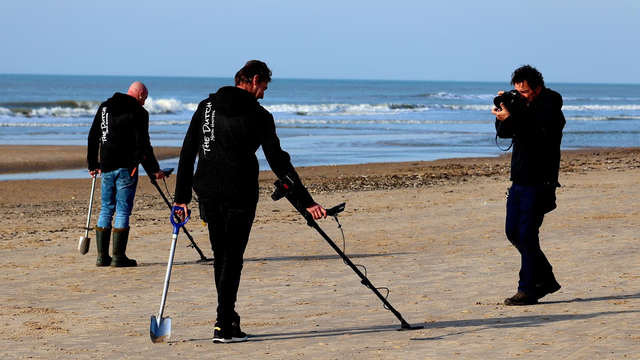
Most people picture the kind of metal detector you can hire in a holiday town or buy for a child. Those work on dry sand. Take one down to the wet sand or into the water and it starts to chatter and beep at nothing, because salt water conducts electricity and the machine reads the sea itself as a target. The person holding it either turns the sensitivity down until it goes quiet, at which point it will walk straight over a gold ring, or gives up.
The machines our detectorists use in the sea handle this in one of two ways. A pulse induction detector ignores the salt almost completely and reaches deep, which makes it the usual choice for wet sand and surf. The drawback is that it sounds off on every piece of metal, so the detectorist digs bottle caps and fishing weights along with the ring. A multi-frequency detector listens on several frequencies at once and can cancel out the salt while still telling the operator something about what the target is. Both types are sealed, with waterproof coils and headphones, so they can go fully under.
The other half of the kit is less glamorous. A long-handled scoop with holes in it lets the detectorist lift a load of sand from the bottom without bending into the waves, and the water washes the sand out and leaves the ring in the basket. Without one, a target in moving water is found and lost again several times.
What the detector picks up is metal, so the same search works for a gold wedding band or an Oura ring, and for a watch too. A phone gives a strong signal. Sunglasses with plastic frames give none, and those are a search by eye in clear water.
How far out a search on foot can go
A detectorist wading can work comfortably to about waist depth, and to chest depth when the sea is flat. Past that they cannot keep the coil steady on the bottom or use the scoop properly, and the search stops being thorough.
That covers more losses than you might expect. Most rings that come off in the sea come off while someone is standing, playing with children in the shallows or diving through a wave, and they were in water they could stand in. The ring drops, settles into the sand within a few minutes and stays put. In wet sand and shallow water it is usually in the top 15 to 25 cm, which is well within reach of a good machine.
Conditions decide how easy the day is. On a calm Mediterranean beach with almost no tide, like the city beaches and coves covered on our Barcelona and Costa Brava page, the ring stays close to where it fell and a search can happen at almost any hour. On surf beaches the picture changes. Around south Bali the waves and the tide move a lot of sand in a day, so a ring can be buried deeper quite quickly, and our finder there plans the search around low tide when the spot may be out of the water altogether. Low tide is the detectorist’s friend everywhere there is one. A ring lost in waist-deep water at high tide can be on bare wet sand six hours later.
The seabed matters as well. Sand is the good case. Pebbles hide a ring between the stones and make the scoop nearly useless. Rock with cracks in it and thick seagrass are harder again, and on those bottoms we will tell you plainly that the chances are lower.
When it becomes a job for a diver
If the ring went in where you could not stand, off a boat or a pier, or while snorkelling out from the beach, a wader cannot reach it. That needs a diver or a strong snorkeller with an underwater detector.
This kind of search can work well in the right place. The clear, calm water around the Greek islands is a good example, because a diver can see the bottom and work a small area carefully. What a diver needs from you is a tight starting point. A boat at anchor swings, and “somewhere off that beach” is too large an area to search by hand at depth. If you can say which side of the boat, how far from a buoy or a rock, and roughly how deep, the job becomes realistic. If you cannot, we would rather say so than take the search on.
Depth and bottom type set the limit. A ring on sand in a few metres of clear water is a fair prospect. A ring in deep water over rock or weed often is not, and no machine changes that.
If your ring has just gone into the sea, there are a few things worth doing before you leave the beach. Stand where you were and line yourself up with two fixed things on shore, such as a lifeguard tower and a building behind it. Note how deep you were, to the knee or the waist, and write down the time, because that tells a detectorist where the waterline was. Take a couple of photos from the spot. Then stop searching with your feet. Shuffling about pushes the ring deeper and spreads the area.
Send us those details through the get help form or on WhatsApp, along with what the ring is made of and when you are leaving. We will tell you honestly whether it is a search for a detectorist on foot or for a diver, and whether we have someone who can reach that beach.