How a Metal Detector Search Grid Actually Works
A professional ring search is slower than people expect. Here is how a search grid is set up, and why overlap decides whether a ring is found or missed.
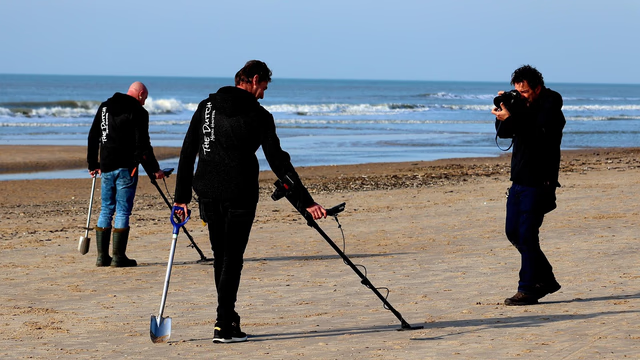
People expect a ring search to look like a treasure hunt. It looks more like mowing a lawn very badly and very slowly, twice, in two directions.
That is not a failure of technique — it is the technique. Everything about a professional search is designed around one uncomfortable fact: a metal detector only sees a narrow strip of ground, and a ring gives one of the weakest, most easily missed signals there is.
The detector sees less than you think
The coil on a detector does not scan a circle of ground beneath it. It projects a field roughly the shape of an inverted cone, and the reliable detection zone for something as small as a ring is narrower than the coil itself.
Two things follow:
Height matters enormously. Lift the coil five centimetres and you lose a meaningful fraction of your depth. A detectorist keeps the coil almost brushing the sand, level through the whole sweep — no arcing up at the ends of the stroke, which is the classic amateur error.
Speed matters just as much. Most detectors need a moment over a target to process the signal. Sweeping quickly moves the coil past a ring before the machine has decided what it is. A correct sweep looks unnaturally slow.
Setting the grid
Before any detecting starts, the search area gets defined and physically bounded. Usually with sand pins, sometimes with a line, sometimes just with landmarks on a bearing.
The area comes from what the owner reported: the marked position, the time of loss, the tide state at that time, and what they were doing. Someone who was towelling off gets a tight rectangle around a known point. Someone who was in the water at high tide three days ago gets a much larger zone, weighted down-drift.
Then the area gets walked in parallel lanes.
Each pass overlaps the last by roughly half a coil width. Gaps are where rings hide.
Why overlap is the whole game
Each pass overlaps the previous one by about half a coil width.
This feels wasteful. It is not. Without overlap, the edges of each lane are covered by the weak outer part of the detection field, exactly where a small gold ring is most likely to be missed. Overlapping means every point of ground passes through the strong centre of the field at least once.
Then the entire grid is walked again at ninety degrees to the first pass.
The reason is that rings are directional. A band lying on its edge presents a very different target to the coil than one lying flat, and a ring that is nearly invisible on a north–south sweep can be obvious on an east–west one. Running the grid twice in two directions is the difference between “we searched it” and “it is not there.”
In practice, a large share of the rings we recover are found on the cross-grid, over ground that had already been covered once.
Reading the ground, not just the machine
A detector is one input. An experienced searcher is also reading:
- The tide line and the wet band. Sand sorts by density. Heavy items migrate to predictable zones, and gold is heavy.
- The slope. On a shelving beach, items work downhill over tide cycles. The search zone usually extends further seaward than the owner expects, and rarely landward.
- Surface disturbance. Where people have been sitting, digging, playing. Compacted areas behave differently from loose ones.
- Junk density. Bottle caps, ring pulls, and foil are the noise a ring hides inside. In a busy area a searcher may dig dozens of false signals — and cannot afford to start ignoring marginal ones, because platinum and white gold often read like junk.
That last point is where most amateur searches quietly fail. Someone borrows a detector, sweeps the area, hears a hundred signals, starts filtering out the “obviously rubbish” ones, and walks straight over the ring.
Depth, and what is realistic
Honest numbers, because there is a lot of nonsense online:
- A gold ring in wet, compacted sand is typically detectable to around 15–25 cm with a good machine and a slow sweep.
- In dry, loose sand the ring may be shallower but the ground is noisier and it moves as you work.
- In saltwater, a detector must be able to handle the conductivity of salt or it produces constant false signals. This is the main reason a general-purpose detector performs badly on a wet beach, and why waterproof, salt-capable machines exist.
- Freshwater lakes and rivers are usually easier electrically, but the bottom is often silt, and silt swallows things.
Beyond roughly 30 cm, a ring-sized gold target is out of reach for practical purposes. This is exactly why the timing advice matters so much: every tide cycle can bury a ring deeper, and there is a point past which no amount of technique helps.
The end of a search that was set up properly at the start.
What this means if you have lost a ring
Two practical takeaways.
First: the quality of your information sets the size of the grid, and the size of the grid sets the odds. A precise marked spot and a known time can turn a full-day search into a one-hour one. Vague information means a large area, and a large area means more passes, more junk, more chances to miss.
Second: a systematic search beats an enthusiastic one, every time. If a friend with a detector has already been over the area and found nothing, that genuinely does not mean the ring is gone. It usually means the ground was covered once, quickly, in one direction, with the marginal signals ignored.
That is not a search. That is a walk with a detector — and it is why we so often find rings in places people have already looked.