
Zadar
Lost a ring in the sea at Zadar?
The Old Town peninsula and the Riva, the Sea Organ, Kolovare and Punta Bajlo, Borik, Puntamika and Diklo, then Petrčane and Kožino.
A phone, a watch or a ring lost in Zadar is usually findable if you can say which piece of the waterfront you were standing on. The city coastline is described as one continuous beach, and that is the difficulty: the word Zadar covers the Old Town quays, the bays at Kolovare, the sand and pebble at Borik, the pines at Petrčane.
Ring Seekers is a lost ring and jewellery recovery service that works with experienced local metal detectorists to search for a ring, wedding band, watch or phone lost in Zadar and along this part of the Croatian coast. This page runs from the peninsula and the Riva out past Punta Bajlo, Puntamika and Diklo to Petrčane and Kožino, and takes in the boats out to the islands.
Tell us what happened and where. We choose an experienced detectorist who knows your beach, brief them with your map and photos, and tell you honestly if the odds are poor.
Everything below is about shrinking the piece of Zadar a search would have to cover.
The one object worth naming before you go
Before you leave, mark the spot on your phone map, then pick out the nearest object that will still be in that exact position next week. A set of steps, a bollard, the edge of the Greeting to the Sun, a bench on the Riva, the sign over a beach bar. Name one of those and a stranger can stand where you stood.
Send it across with a photograph taken along the shore rather than out to sea, a picture of the item, and a line saying whether you were walking, sitting or in the water when you last had it.
Places we cover in Zadar
- Zadar Old Town and the peninsula
- Kalelarga
- Petar Zoranić Square
- The Riva seafront
- The Sea Organ
- The Greeting to the Sun
- Kolovare beach and its bays
- The city seawater pool at Kolovare
- Punta Bajlo
- Borik
- Puntamika
- The Diklo coastline
- Vitrenjak and its marina
- Zadar port and Gaženica
- Petrčane and the Žal beach
- Kožino
- The boats across to Ugljan and Pašman
- Dugi otok, Sali, Zaglav and Brbinj
- Telašćica bay and Lake Mir
- The Kornati boats and Lojena beach
Six parts of Zadar, and what people can name in each
The peninsula, the seafront, the city beaches, the shore out to Diklo, the villages and the port.
The peninsula and Kalelarga
The old centre stands on a peninsula, and Kalelarga has been the main street of the city from the most ancient times. Petar Zoranić Square and the Riva are the other names people navigate by there, so give us the street or the square and the way you walked between them.
The Riva, the Sea Organ and the Greeting to the Sun
The Riva is the Zadar seafront, a promenade under palm trees and old holm oaks looking across at Ugljan and Pašman. The Greeting to the Sun stands on the western point of the peninsula, a circle of three hundred glass plates twenty two metres across, and right beside it the Sea Organ runs about seventy metres along the waterfront as broad steps going down into the sea.
Kolovare and the path out to Punta Bajlo
Kolovare is the city beach, a few steps from the centre, a run of bays with the city seawater pool along it rather than one continuous strip. From Kolovare the path carries on to Punta Bajlo, which is rock. People describe both as Kolovare, so say which one you settled on.
Borik, Puntamika, Diklo and Vitrenjak
The route towards Puntamika reaches Borik, where the beach is pebble and sandy with an aquapark and beach bars behind it. The whole Diklo coastline is swimmable, and Vitrenjak is a beach with a marina behind it and a playground on it. Naming the bar, the marina or the playground puts a detectorist on the right part of that shore.
Petrčane and Kožino
Petrčane lies between Zadar and Nin, a village on slopes with olive groves and vineyards around it. Its beaches are pebble, sand and concrete under the pines, and the shallow part of that coastline runs almost five kilometres before the ground drops away more steeply. Kožino is about ten kilometres from Zadar, quieter, with sandy and pebble beaches.
The port and the boats out to the islands
Zadar is connected to all of its islands through the whole year, and the cruise port at Gaženica sits near the old city centre. The fast line runs to Sali and Zaglav, the ferry line to Brbinj, and excursion boats leave from Zadar itself as well as from Biograd, Pašman and Ugljan. Many head for Telašćica at the southern end of Dugi otok, where Lake Mir sits on a narrow band of land between the open sea and the bay. Kornati day boats stop for a swim, often at Lojena on Levrnaka, a sand and rock beach.
What happens once you message us about Zadar
You write it down once
Everything lands in a single WhatsApp thread. What you type at eleven at night is still sitting there in the morning, in your own words, and that is the version a detectorist gets.
The asking around happens at our end
Nobody is stationed on the Riva waiting for a call. Once your message is in, that part is ours: finding a metal detectorist free to get to that particular stretch of Zadar, and passing on your pin and pictures untouched.
Some of it will not be worth doing
If your account of the afternoon reads badly to us, we say so in the reply, before you have agreed to anything at all.
The surface changes within one bus ride
Paved square in the Old Town, bays at Kolovare, rock at Punta Bajlo, pebble and sand at Borik, concrete at Petrčane. Which one you spent the day on changes the whole shape of the job.
You decide with the number in front of you
The costs are put to you in writing first. Nothing at all is arranged until you have read that and replied.
What the ground and the water are doing here
One city coastline, and it changes material several times over.
One coastline, not one material
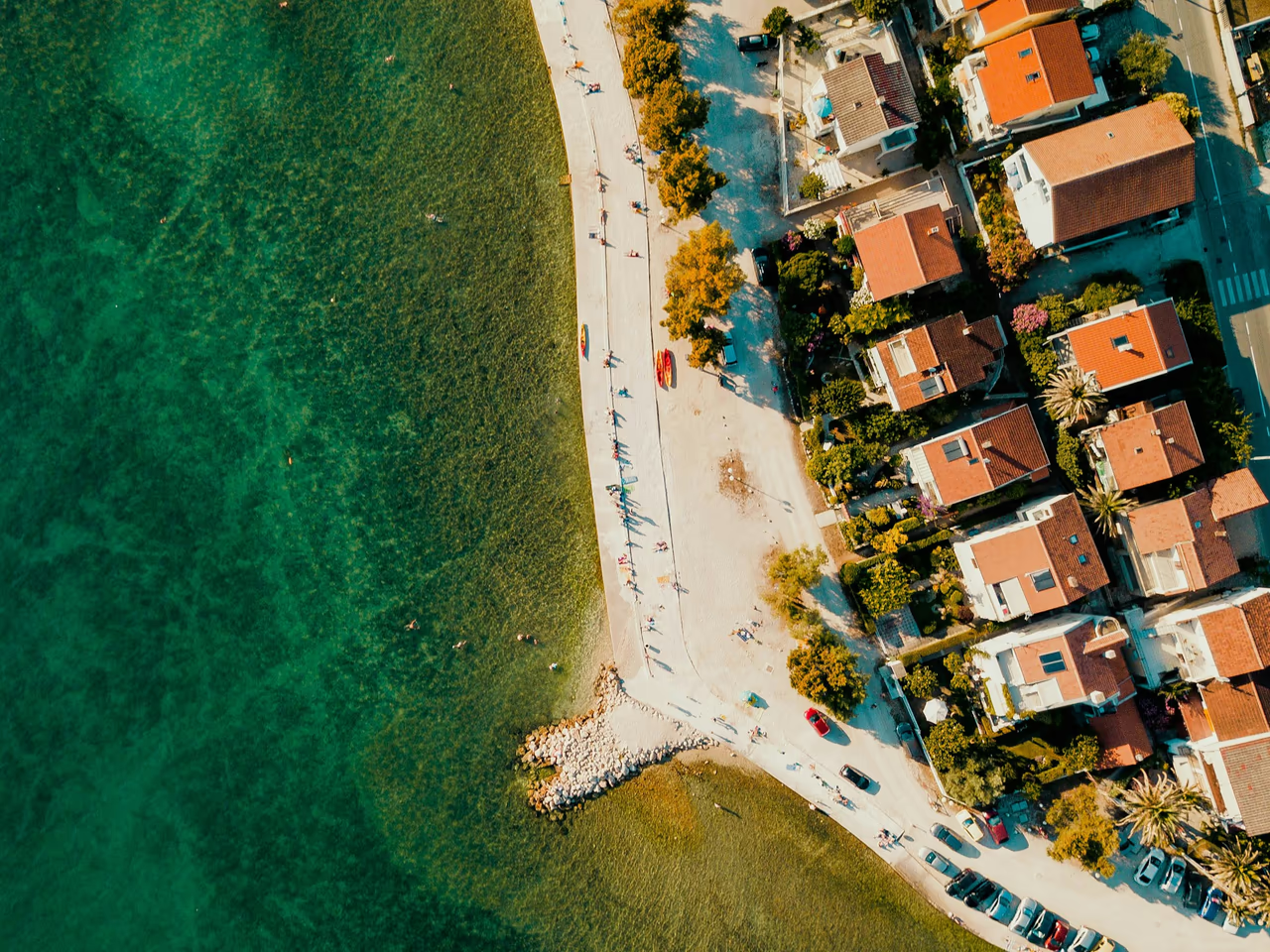
Kolovare is bays close to the centre, Punta Bajlo is rock, Borik is pebble and sand, Kožino is sand and pebble, and Petrčane adds concrete. Start with that, because it is the one detail that separates five very different jobs.
Nearly everything here has a built edge
The Riva, the steps of the Sea Organ, the marina at Vitrenjak and the quays in the port are all made ground, and that is where most people get into the water. Stone and concrete do not wander, so what you photograph tonight is what a detectorist turns up to.
People stay on those steps for hours
People settle on the Sea Organ steps and around the glass circle beside them and stay put, and a small thing put down on stone there is easy to walk away from. If that was your evening, say which end you were at.
Want a first idea of your chances? Try the lost ring recovery calculator.
Questions about Zadar
A phone went into the water from the Sea Organ steps. Where would anyone start?
With which end of them you were on. The Sea Organ runs about seventy metres along the waterfront as broad steps going down into the sea, and the Greeting to the Sun stands beside it, a circle of glass plates twenty two metres across. Between those two you can place yourself without a street name.
Our wedding band is somewhere on Kolovare and we cannot narrow it down further.
Kolovare is not one strip. It is a run of bays a few steps from the city centre, so two families who both say Kolovare can be nowhere near each other. Give us the bay, or the point on the promenade you came down. A band can come off in the water without you feeling it go, so say if you had been swimming.
A watch came off at Borik. Does it matter whether we were on pebble or on sand?
It matters, because Borik is both. The beach there is pebble and sandy, with the aquapark and the beach bars behind it to count along from. Tell us which surface you were lying on and which bar you were nearest.
We were at Petrčane all day and only missed the ring back at the hotel. What do you need?
A name at one end of the village. Petrčane lies between Zadar and Nin, and the shallow part of its coastline runs almost five kilometres, so the village name alone is a long walk. The Žal beach and the peninsula the Pinija hotel stands on are two separate afternoons.
We lost an earring and an Oura ring at Kožino. Does a village that quiet help or not?
It helps. Kožino sits about ten kilometres from Zadar and has sandy and pebble beaches, and a quiet beach keeps its shape from one day to the next. Tell us which beach you went down to, where you left the car, and roughly where your towels were.
A chain is missing somewhere along Kalelarga. Is paving hopeless?
Not hopeless, but it is worked differently from a beach. Kalelarga has been the main street since the oldest days of Zadar and the whole city walks it, so one pin on it tells us little. Send the route, from where you set off to where you noticed, and where you stopped along the way.
It went over the side of a boat on a day out to Dugi otok or the Kornati. Can that be worked?
The dry part of that day can. Zadar is connected to all of its islands through the year by fast boats, catamarans and ferries, so a trip like that takes in a quay, a deck and a beach at the far end. If it went over the side in open water, that is a long shot, and you would hear that from us first.
Our flight is at six and we marked nothing. Is there any point now?
There is. Write it tonight rather than from the airport, because your memory of the afternoon is what a search actually runs on, and it fades faster than people expect. Even a rough pin and a few lines are better than leaving with nothing written.
Zadar
Name the stone you were standing next to
Which beach or which part of the waterfront, what stood behind you, how far out you got, and a clear picture of what is missing.
Send it in one go. The reply tells you plainly how your chances look and what searching that spot involves, and you take it from there.