Lost a ring in Menorca at Cala Macarella or Son Bou
Lost a ring at Cala Macarella, Son Bou or another Menorca beach? Why the coves and the long south coast sand behave differently, and what to do first.
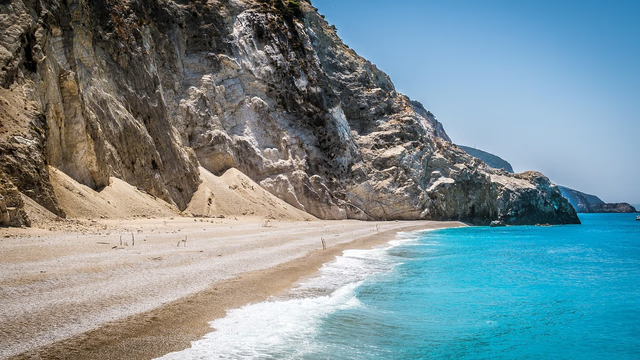
If your ring has just slipped off at Cala Macarella or somewhere along Son Bou, the first thing to know is that Menorca is one of the kinder places in the Mediterranean to lose something. The island’s south coast coves are sheltered, the sea barely has a tide, and a ring that drops into soft sand tends to sink down and stay there. It does not usually get carried away.
That is not a promise. Rings do get lost for good in Menorca, mostly in deeper water or among rocks. But if it went into sand, on the beach or in the first stretch of shallow water, the odds are usually better than people expect when they are standing there in shock.
Before anything else, mark the spot. Take a photo from where you were sitting or standing, with something fixed in the background like a rock, a lifeguard chair or a beach bar sign. Then stop digging with your hands. Sifting through dry sand feels like the right thing to do, but it mostly pushes a ring deeper and spreads the area out.
Why the coves are a good place to search
Cala Macarella and its little neighbour Macarelleta are classic Menorcan coves. A horseshoe of pale sand, pine trees down to the edge, limestone cliffs either side and water so clear you can see the bottom. Cala en Turqueta and Cala Galdana are similar in shape, just bigger or smaller.
That shape matters. The headlands block most of the swell, so on a calm summer day the water inside a cove barely moves. A ring lost while swimming tends to drop more or less straight down and settle into the sand on the bottom. On the beach itself, it works its way down through the loose sand as people walk over it. Either way it is still there, it has just gone out of sight.
In the coves the real difficulty is usually the crowd. Macarella gets very busy in July and August, and a ring lost in the middle of the beach at four in the afternoon will have hundreds of feet walking over it before evening. That does not move it far, but it does push it down and makes the area harder to pin down if nobody marked the spot. A search early in the morning, before the beach fills up, is far easier than one in the middle of the day.
If the ring went in among the rocks at the side of a cove, where people climb out of the water or jump in, it is a harder job. Rings fall into cracks and between boulders, and a metal detector can only help so much there. Sometimes a diver with a mask and a good eye does better than a machine. We will tell you honestly which kind of search makes sense.
Son Bou and the long beaches of the south
Son Bou is a different kind of place. It is the longest beach on the island, a broad sweep of sand on the south coast with dunes behind it and the hotels at one end. The sea shelves gently, so people walk a long way out and stand chatting in water up to their waist. That is where a lot of rings come off, usually because cool water and sun cream make fingers slimmer and slippery at the same time.
On a long, open beach like this, the first question is how well you know where you were. “Somewhere in front of the second beach bar” is a much bigger area than “level with the umbrella with the blue stripe, about ten steps out”. Neither is hopeless. The more precise you can be, the shorter and more focused the search is.
Son Bou does get more wave action than the sheltered coves when the wind comes from the south, and that can shift sand around in the shallows. A ring lost in calm weather and searched for within a day or two is in a better position than one lost just before a windy spell. If the weather is turning, it is worth getting in touch sooner rather than later.
Other open beaches on the south coast, like Sant Tomàs or Punta Prima, behave in a similar way. The north coast is different again. When the Tramuntana wind blows from the north, beaches like Cala Pregonda and Arenal d’en Castell can take a real battering, and sand and seaweed get moved about. If you lost something on that side of the island during a windy few days, say so when you contact us, because it changes how the search is planned.
The seagrass, the seaweed and the sand
One thing that catches visitors out in Menorca is the seagrass. The sea floor off many beaches is covered in meadows of Posidonia, and its dead leaves wash up in thick brown banks along the shore, especially early and late in the season. A ring can disappear into those banks very easily. If you lost it at the water’s edge and there is a line of dried seaweed nearby, mention it. A detector reads through a seaweed bank without any trouble, but the search has to cover it on purpose.
Out in the water, a ring that falls onto the seagrass meadow itself can be much harder to reach than one on bare sand. The leaves are dense and the roots hold the sea bed together. That is one of the situations where we will tell you plainly that the odds are lower.
Menorca’s beaches also swallow bracelets and earrings, watches and Oura rings, and phones dropped off paddleboards. Anything metal will show up on a detector, including metal-framed sunglasses. Plastic sunglasses will not, so those are a search by eye or by a snorkeller, and we would say so.
If you are travelling around the islands, the same advice applies on the other side of the water too. The coves in Mallorca and the calas of Ibiza and Formentera work in much the same way, sheltered sand with very little tide, and we arrange searches there through the same kind of local detectorists.
The single most useful thing you can do, after marking the spot, is tell us early. Send us a message through the get help form or on WhatsApp with the beach name and roughly when it happened. You do not need to send the exact spot in the first message. We will ask a few simple questions, explain how a search would work on that particular beach, and explain the costs before any search is booked. Then we arrange a local detectorist for you. More about how we cover the island is on our Menorca page.
If you are flying home soon, say so straight away. A search can often be done after you leave, as long as we have a good photo of the spot and a clear description of where you were.