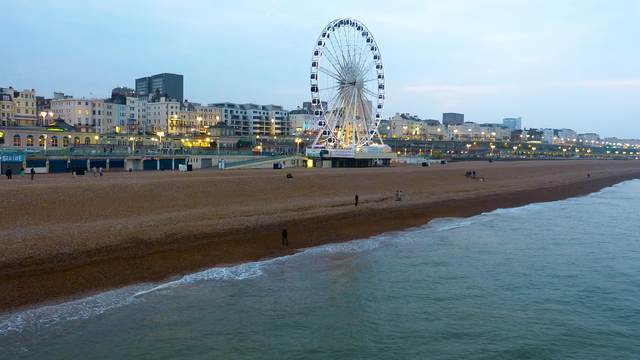
Lost a ring on a Sicilian beach at Cefalù, Mondello or Taormina
Lost a ring at Mondello, Cefalù or Taormina? What to do in the first few minutes, how Sicilian sand and pebble behave, and how a search works.
You walk out of the water at Mondello, reach for your hand out of habit, and the ring is not there. Or you are shaking out a towel on the sand below the rock at Cefalù and hear nothing at all, which is exactly how most losses happen. There is no splash, no clink. The thing is simply gone, and the beach in front of you is suddenly enormous.
The ring is almost certainly still there. Rings do not travel. Unless you were swimming out past the shallows, it is within a few metres of where you last had it, and what decides whether anyone can recover it is mostly what you do in the next few minutes, before anybody gets a detector anywhere near the place.
Sicily is worth writing about on its own because the island does not have one kind of beach. The bay at Mondello and the long strand at Cefalù are soft sand, sheltered and shallow. Down the east coast at Taormina you are on grey volcanic pebble with deep water close in. Those are different jobs with different odds, and it helps to know which one you are standing on.
Stop walking. That sounds too simple to matter, and it is the single most useful thing you can do. Every step after the loss pushes a shallow ring deeper into the sand and quietly erases your own memory of where you were standing. People are confident about the spot for about a minute and a half. After that, an unmarked beach starts to look identical in all directions.
Put something down where you are. A towel, a bag, a bottle, a stick pushed into the sand. Then look inland and pick two fixed things you can line yourself up with later, a lifeguard tower and a particular building, a gap in the rocks and a kiosk. Take a photograph from where you are standing, facing the sea, and another facing the land. A phone photo with its location still attached is worth more than any description you can write out afterwards.
Then write down the time, and whether the sea was flat or moving. If you were in the water, note roughly how deep it was against your body, because waist deep and chest deep are different searches.
Do not dig, and do not let a group of helpful people rake the area with their hands and feet. Sand that has been turned over is the hardest ground a detectorist can be given. A buried ring in undisturbed sand is a problem with a shape. A ring somewhere in a churned patch fifteen metres across is a much worse one.
Soft sand at Mondello and Cefalù
Mondello is the gentlest beach we deal with in Sicily, and gentle is good news. The bay sits between two headlands, so the swell that reaches it is small, and the water stays shallow a long way out. Fine pale sand, very little movement. A ring that goes in there tends to stay put, and the sea is not going to carry it along the coast overnight. If you can get a search organised within a day or two, the odds are reasonable.
The catch at Mondello is the dry sand up by the loungers. Fine dry sand behaves almost like a liquid when it is walked on, and a ring dropped while you are dressing can work its way down surprisingly fast once a few hundred people have crossed the same patch. That is also where most losses happen, by the way. Cold water shrinks fingers and takes rings off in the sea, but the towel, the sun cream and the changing all happen on land.
Cefalù is a longer, more open beach under the old town and the rock, and the sand there is a little coarser. It shelves gently, which means the wet band at the water’s edge is wide and easy to cover properly. In wet sand a ring usually sits somewhere in the top 15 to 25 cm, within a detector’s reach. The dry sand higher up the beach is where things go deeper.
Both of those beaches get busy, and busy sand is full of ring pulls and bottle tops. That is normal and it is not a problem in itself. It just means a search is slower, because every signal has to be checked rather than walked past.
Pebbles and deep water at Taormina
Taormina is a different proposition. The beaches around Isola Bella and Mazzarò are coarse grey stone rather than sand, and the ground drops away quickly, so you are in genuinely deep water not far from the shore.
Stone changes everything. A ring that lands on pebble sometimes sits on top, plainly visible, and people find it themselves in five minutes. More often it slips down between the stones, and where sand holds a ring at a fairly predictable depth, loose pebble can let it drop below what a detector coil can reach. Grinding swell moves those stones about, and a ring goes down with them.
Volcanic ground has its own quirk too. Mineralised black sand and lava stone give a detector a busy, noisy background, and a machine has to be balanced to the ground before anything sensible comes out of it. It is doable, our finder on the island does it, but it makes the search slower and it makes a careless search useless.
The honest summary for that stretch of coast is that a loss in the shallows or on the beach itself is worth trying, and a ring that went off a boat or off the rocks into deep water is a job for a diver, if it is a job at all. We would rather tell you that up front than take you down to the water and shrug.
What to send us
A few details decide whether a search is worth starting, so send them early. Which beach, and which end of it. What time it happened. Whether you were on dry sand, in the wet band or in the water, and how deep. What the ring is made of, because platinum and white gold give a quieter signal than yellow gold and a finder needs to know what to listen for. Anything engraved inside it. Your photographs of the spot.
The same applies to the other things that come off in the sea and never get mentioned until later. Watches, smart rings such as an Oura, earrings, chains and bracelets are all metal and all findable. Phones and car keys turn up too. Plastic sunglasses do not read on a detector at all, so those are a search by eye or by a diver in clear water.
Send what you have through the get help form or on WhatsApp, and we will tell you honestly what we think the chances are before anything is arranged. We explain the costs before any search is booked.