
Why a ring lost on Brighton's pebble beach is harder to find
Lost a ring on the shingle at Brighton, Hove or Eastbourne? How pebbles hide a ring, what storms do to it, and when a search still makes sense.
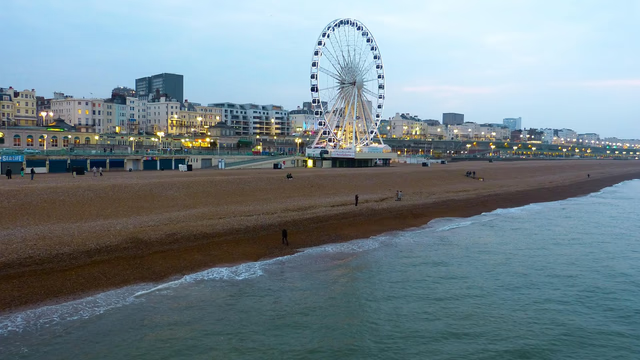
Most people who lose a ring on Brighton beach say the same thing when they get in touch. They heard it land, or they felt it go, and they looked down straight away. And there was nothing there. Just pebbles, thousands of them, all roughly the same colour as a gold band in the afternoon light.
That first half hour of turning over stones by hand is where a lot of rings are lost for good. So before anything else, here is the short version. Stop moving pebbles and mark where you are standing, then send us the details. A ring on shingle is harder to recover than a ring on sand, but it is often still there, and a detectorist has a much better chance than a pair of hands.
What shingle does to a ring
On a sandy beach a dropped ring sits on the surface or sinks a little way into the sand. Shingle is different. Between the pebbles there are gaps, and a ring is small and heavy enough to fall straight into them. Every time someone walks past, or you shift a few stones looking for it, the pebbles settle and the ring works further down. People are often surprised how deep it goes on a beach that looks solid.
Searching by hand makes it worse. You lift a stone, the stones around it roll into the hole, and anything underneath slides lower. After twenty minutes of looking, the spot where the ring fell can be a shallow crater with the ring somewhere below it. That is why we ask people to stop searching and step back, even though every instinct says keep going.
A detector does not care what the stones look like. It hears the metal through them. The harder part on shingle is recovering the target once it has been found, because a hole in pebbles keeps collapsing. A finder who works Brighton regularly will use a long handled scoop with holes in it, so the stones fall through and the ring stays in the basket. It is slow work, but it is the right tool for this beach.
Brighton also has plenty of rubbish metal in the stones. Ring pulls, bottle caps, foil and coins turn up everywhere near the pier and the bars along the front. An experienced detectorist learns to tell these apart by sound, but it still means more digging than on a quiet beach, so the more precisely you can mark the spot, the better.
The same goes for a watch or an Oura ring that comes off at the water’s edge, or an earring dropped while lying on a towel. Anything with metal in it shows up. Plastic sunglasses do not, so those are a search by eye.
Storms and the tide move the pebbles
The Sussex coast has a much bigger tide than Bournemouth or Poole, and the pebbles do not sit still. Waves push shingle along the beach, which is why Brighton and Hove have groynes every few hundred metres to hold it in place. After a rough night the beach can look different. A ridge of pebbles appears where there was a slope, or a stretch of sand shows at the bottom that was covered the day before.
For a lost ring this matters in two ways. A ring dropped high up on the dry shingle, near where people sit, is usually the best case. Waves rarely reach it in summer, so it stays where it fell, even if it has worked down between the stones. A ring lost at the water’s edge or in the shallows is a harder job. The pebbles there are moved by every tide, and a spell of south westerly weather can shift a ring along the beach or bury it deeper under a new layer of stones.
Low tide is when a detectorist wants to search the lower beach. At Brighton and Hove, a big low tide uncovers a strip of sand below the shingle, and a ring that slid down the slope sometimes ends up there. That strip is not there every day, so the search gets planned around the tide table. Early mornings help too, before the beach fills up.
Further east the picture changes a little. Eastbourne has shingle at the top and sand at low water, while Camber Sands is almost all sand and runs out a long way. Along the Sussex coast no two beaches behave quite alike, which is one reason we ask exactly where you were.
What to do before you leave the beach
Do not dig. Stand where you think it happened and line yourself up with two things that will not move. At Brighton that could be a groyne and the pier, or a numbered lamp post on the promenade above you. Take one photo looking out to sea and one looking back up the beach. Drop a pin on your phone’s map, and write down the time.
If a friend was sitting with you, ask them to mark where your bag or towel was too. People remember different things, and two memories of the same spot are often better than one.
Ask at the lifeguard station and any café or kiosk nearby. Jewellery does get handed in, and leaving a phone number costs nothing.
Then get in touch. Send the photos and the pin through the get help form or on WhatsApp, with a picture of the ring and what it is made of. Yellow gold gives a clear signal. White gold, platinum and titanium are quieter, and a finder listens for them differently. If there is an engraving, tell us, because it helps prove the ring is yours if somebody else finds it first.
We have detectorist contacts in Sussex and in Kent, and Britain has a well established ring finding scene. People who do this in their own time, because they like handing a wedding band back to the person who lost it. We pass your details to someone who knows how this coast behaves and can plan around the tide. We explain the costs before any search is booked, and if the odds look poor we will say so before anyone makes the trip.
Some searches do not end with a ring. If it went into the sea at high tide and a storm followed, the chances fall, and a straight answer is kinder than false hope. But a ring dropped on the dry shingle on a calm day, reported quickly with a good pin, is a fair case, even on pebbles.
If you were somewhere else on the south coast, the same advice holds on the shingle and sand of the Kent and Essex coast and at Chesil or Southsea on the Dorset and Hampshire coast. Mark the spot and leave the pebbles alone, then send us the details today through the get help form or WhatsApp.