
Searching black volcanic sand for a lost ring
For detectorists. How black volcanic sand affects a metal detector, how to ground balance on it and how to search it for one lost ring.
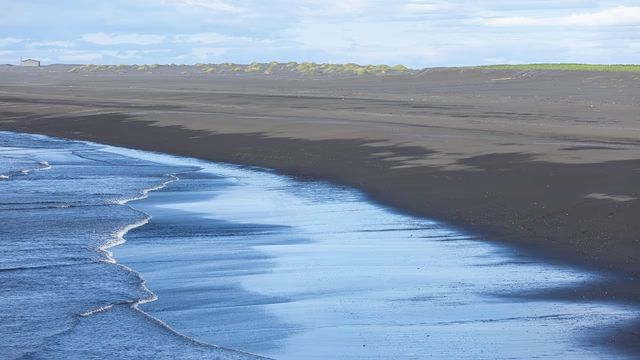
The first time you switch a detector on over black sand, it can sound as if the whole beach is full of targets. The threshold wobbles and the machine grunts every time you lift the coil. A gold ring a hand’s depth down can be harder to hear than it would be on pale sand. Black volcanic sand is some of the most awkward ground there is for a lost ring search. It is also where plenty of rings go missing, because the beaches that have it are often busy holiday beaches.
This post is for detectorists who take on searches for one specific ring, watch or Oura ring and find themselves on dark sand.
Why black sand upsets a detector
Most black beach sand gets its colour from crushed volcanic rock, and a good share of it is magnetite, a naturally magnetic iron mineral. If you run a strong magnet through a handful of it, the dark grains jump up and stick. Your detector feels that too. To a standard single frequency VLF machine, a beach full of magnetite reads like a weak, endless iron target, and wet salt sand on top of it adds a second signal of its own.
What makes it tricky is that the mineral is rarely spread evenly. Storms and big tides sort the sand, so you get streaks and bands of almost pure black grains next to patches that are much lighter. Walk across a beach like Playa Jardín in Puerto de la Cruz or Playa de la Arena near Los Gigantes on Tenerife and the ground can change under your coil every few metres. On the west coast of Bali, from Echo Beach and Batu Bolong to Berawa (our Canggu and west Bali page covers that stretch), the sand is dark grey to black and the surf keeps reworking it.
Compare that with the pale coral sand at Nusa Dua on our south Bali page. Same island, very different search. On the white sand the machine runs quiet and deep. On the black sand you are working for every centimetre.
Setting up the detector
Ground balance is the whole job here. If your machine has automatic ground balance, pump it over clean sand right where you are going to search, not at the top of the beach where the mix is different. If it has a tracking mode, it can help on beaches where the mineral changes a lot, though be aware that tracking can slowly tune out a faint target if you keep sweeping over it. Many detectorists balance manually at the start, then rebalance each time they move into a visibly darker or lighter patch.
Drop the sensitivity until the threshold is steady. It feels wrong to give up depth on purpose, but a machine that is chattering all the time costs you more, because the small, faint signal from a thin wedding band gets lost in the noise. A slightly lower setting that runs smooth will usually hear more than a high setting that falses.
Pulse induction machines and multi frequency machines tend to cope better with magnetite and salt together, which is why many beach hunters use them on volcanic coasts. If you only have a single frequency VLF, it can still work. You will just need to go slower and accept a little less depth.
Be careful with discrimination. Heavy iron mineral can pull the readings on a real target, and a gold ring sitting in a band of black sand may not show the number you would expect on light sand. If you have notched out low conductors to cut down on foil, you may notch out the ring as well. On a search for one ring it is better to dig more and miss less.
A pinpointer can play up too. Some will false on strongly magnetic sand, so detune it, or switch it on in the air and then bring it down onto the sand, if yours works that way.
Searching and digging on dark sand
Start with what the owner tells you. Which part of the beach, how far from the water, and what they were doing when they noticed. Ask them to send a photo or a map pin if they have one, because black beaches often have few landmarks and one stretch looks very like the next. If they want to talk it through first, they usually send us the details first through our get help form, and we pass the whole description on to you before the search.
Mark a grid with towels or sticks. Work slowly, with the coil low and level, and overlap each sweep by about half the coil. On mineralised ground a fast or uneven sweep is what sets off most of the false signals. Lifting the coil at the end of each swing does the same, so keep it flat and close the whole way across.
Pay attention to the bands of very black sand. Magnetite is heavy, and the water tends to drop heavy things in the same places. After rough weather the darkest streaks are often where small, dense items have settled too, so rings and earrings often turn up along them. They are also the noisiest part of the beach to search, which is a real frustration. Go over them twice, once in each direction.
Dig with a long handled scoop, and check every scoop with the detector rather than by eye. A gold band covered in wet black sand is almost invisible, and it is easy to tip it straight back out with the spoil. Shake the scoop out slowly over a light coloured cloth or tray if you have one. It makes a small ring far easier to see.
Two practical things catch people out. Black sand gets very hot in the sun, hot enough to make kneeling or working barefoot unpleasant by late morning, so start early. And the dark grains get into everything, including coil covers and scoop hinges, where they can rub. Rinse your kit in fresh water after each search.
If the first pass finds nothing, rebalance, cross the grid at right angles and then widen it down towards the waterline. In surf like the west coast of Bali, a ring that went in at knee depth can be moved quite a way in a day or two, so ask the owner about the tides and when they went in.
Ring Seekers helps people who have lost a ring on the beaches we cover, and an experienced local detectorist does the search. If you already work volcanic beaches with a detector and would like to help people get back rings they thought they had lost, we would be glad to hear from you through our page for detectorists.