Losing a ring on the small beaches of Monaco and Menton
Larvotto, the Sablettes and Garavan Bay are small, sheltered and busy. What that means for a ring lost there, and how a search on a managed beach starts.
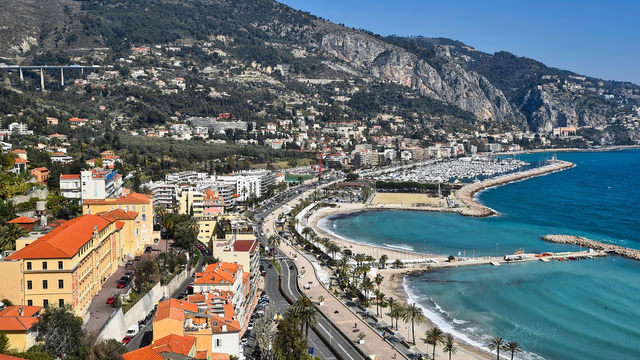
The last few kilometres of the French coast, from Monaco through Roquebrune to Menton and the Italian border, have some of the smallest beaches on the Riviera. The mountains come down almost to the water, the road and the railway take what is left, and the beach is whatever strip remains. People who lose a ring there often assume that makes it hopeless. It usually does the opposite.
A small bay with breakwaters at each end, almost no tide and calm water is about the most contained place you can lose something in the sea. Nothing is sweeping it a hundred metres down the coast overnight. The ring is very probably within a few metres of where it came off, and it will still be there tomorrow. What decides the outcome here is what the ring is sitting in, and when the beach is clear enough to search it.
Gravel in Monaco, shingle in Menton, sand at Villefranche
Larvotto, the main beach in Monaco, is a built beach. The material was brought in and it is held in place between breakwaters, so you are standing on coarse gravel rather than soft sand, and the water in front of it is sheltered and shallow for a decent stretch before the bottom falls away. The sheltering is good news. The gravel is not. A ring dropped on loose stone does not sit on top of it. It works its way down between the pieces, and how far it goes depends on the size of the stones and whether anything is moving them.
Menton is much the same story in a different shape. The Plage des Sablettes sits in a curve under the old town, small and busy through the season, and it is shingle with some coarse sand mixed in. Garavan, further east towards the border, is quieter and stonier. Between Monaco and Menton you have the Roquebrune beaches, which shift between gravel and sand depending where you put your towel down. On any of these, the dry part of the beach above the waterline is the better case. A ring that goes in there tends to stop in the first few centimetres and stay put, because nothing is stirring the stones. A ring that goes into wet shingle at the water’s edge is a harder job, because every wave rearranges the top layer and works it deeper.
It is worth knowing what the good version looks like, since it is only a short way along the same coast. Villefranche-sur-Mer has real sand at the Plage des Marinières, in a deep and unusually calm bay. Sand holds a ring near the surface, a detectorist can grid it properly, and the odds change completely. If you were in Villefranche rather than Monaco, say so early, because it is a different kind of search and we will treat it as one.
Club beaches and the hours when the beds are cleared
Almost everything along this stretch of seafront is run by somebody. Beach clubs and concessions lay out mattresses and parasols in rows each morning and clear them at the end of the day, and in Monaco in particular the whole waterfront is managed and tidy. Plenty of rings are lost on exactly those rows. Somebody slips one off for sun cream, puts it down on a towel, and it disappears into the gravel under the mattress.
A search on that ground is possible, and it is planned for the hours when the beach is clear, so an early morning before the loungers go out or an evening after they come in. A coil cannot read through a bed of mattresses and decking, and the beach club knows its rows and its hours, which helps with the timing. Note the name of the club and roughly which row you were on, because that is a real starting point when the search is planned.
Before any of that, ask at the club’s own desk and at the local lost property office. Staff who set out and pack up a beach every day find jewellery, and on a small managed beach the chance that it was picked up and handed in is higher than on an open stretch of sand. It is always worth asking, and we would far rather you got the ring back that way than had to book a search at all.
What to do now, and what to tell us
Stop where you are and mark the spot before you do anything else. On a club beach that means the row and the lounger number, plus a photo along the row. On an open beach, line up something fixed behind you, a set of steps or the end of a breakwater, and photograph the view in both directions from where you stood.
Do not dig through the stones with your hands. On sand that buries a ring. On shingle it can drop it through several layers in one movement, which is often the difference between a search that works and one that does not.
This corner of the coast sees more than its share of expensive jewellery, and a valuable ring changes what we need from you rather than what we can promise you. If there is an engraving inside the band, tell us what it says. If you have a jeweller’s photo, a valuation document with a description, or even a decent holiday snap with your hand in it, send that as well. A ring that can be described precisely is a ring you can claim with confidence if somebody else has already picked it up and handed it in.
Tell us the metal too. Platinum and white gold read on a detector in a way that is easy to dismiss as rubbish, and so does a thin band set with stones. A finder who knows in advance what they are listening for will dig signals they would otherwise walk past. And if you would rather the whole thing stayed quiet, it will. We do not publish customer details or photographs without being asked to.
Send it all through the get help form or on WhatsApp, with the beach, the time it happened, whether you were on dry stones or in the water, and how deep the water was if you were in it. We ask for the exact spot later, in private, once you decide to go ahead. We look for an experienced detectorist who can get to that beach, and the pages for Menton and Nice explain how our coverage works at each end of it. This is a compact stretch of coastline, so a search here is more a question of being on the right beach at the right hour than of travelling any distance.
One last thing, because it is the question everybody asks. A ring that went into dry gravel beside a lounger yesterday is a good search. A ring that went into wet shingle at the waterline a fortnight ago, through a windy spell, may be deeper than any machine can hear, and you should be told that before you spend a day hoping. Send the details early and the answer is far more often the first kind. Ring Seekers arranges searches for lost rings and jewellery along the Riviera, carried out by experienced metal detectorists.