Why the Albanian Riviera has become a hotspot for lost rings
Ksamil, Sarandë and Dhërmi now fill up every summer. What the sand and pebbles there mean for a lost ring, and how a search on that coast works.
The Albanian coast south of Vlorë was a quiet place not very long ago. Now the road down through the Llogara pass is busy from June, the beaches below it fill by ten in the morning, and the coves at Ksamil are booked out weeks ahead. More people swimming in warm water means more jewellery coming off in it, and we get more messages from that coastline every season.
If you are reading this with wet feet and a bare finger, the short version is that this is one of the better places in Europe to lose a ring. The tide barely moves. The water is clear and often shallow for a long way out. The ring is very probably still within a few metres of where it left your hand. What changes the odds from one beach to the next is what you were standing on.
White sand at Ksamil, pebbles further north
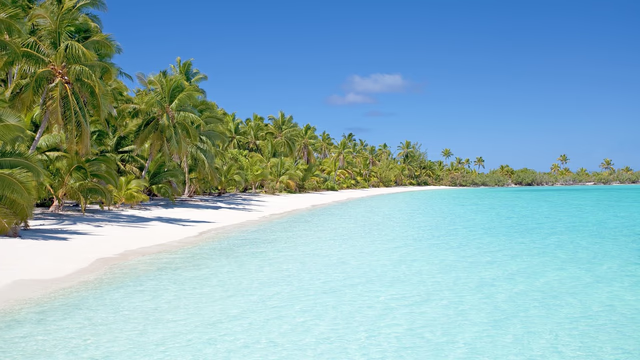
Ksamil is the soft end of this coast. Fine pale sand and small bays, with that shallow turquoise water people come for and the little islands close enough to swim to. Sand is the ground a detectorist wants. A ring dropped in it usually sits in the top 15 to 25 cm, it stays where it fell if nothing stirs it, and a search can be gridded properly so that no strip gets missed. The swim out to the islands is where we hear about most losses. Cold water and a bit of effort with the arms is all it takes for a loose band to come off, and people rarely notice at the moment it happens.
Dhërmi is a different surface entirely. The long strip there is pebble, graded from small stones at the top of the beach to larger ones at the water, and Drymades and Jale along the same stretch are much the same. A ring landing on loose stone does not rest on top of it. It slips down between the pieces, and how far it travels depends on the size of the stones and whether the sea is working them. Dry pebble above the waterline is the good case, because nothing is moving up there and the ring tends to stop in the first few centimetres. Wet pebble at the edge, with a swell running, is the hard one.
Sarandë sits between the two. The town beaches and the promenade stretch have coarse sand with stone mixed through it, and the bays either side of the port change character every few hundred metres. It is worth being precise with us about where you were, because the answer for one end of that bay is not the answer for the other.
Calm water is the reason the odds here are decent
The Ionian on this coast has almost no tide to speak of. There is no twice daily cycle dragging the top layer of a beach out and putting it back somewhere else, which is what makes a lost ring on an Atlantic beach such a race against the clock. Here a ring lost in knee deep water on Tuesday is usually still in that same patch on Friday.
The thing that does move sand and stone here is weather. A windy spell with real swell will rearrange the shallows, push material up the beach and bury things deeper. That is the clock you are actually racing, and it is a weather forecast rather than a tide table. If a blow is coming, tell us, because it changes when a search should happen rather than whether it is worth doing.
Depth matters too. If you were standing in water up to your knees or your waist, a detectorist in a wetsuit with a waterproof machine can work that ground. If the ring came off while you were swimming over the drop, off a boat, or near the rocks at the end of a cove, that becomes a job for a diver and the honest answer depends on how deep and how rocky. Rings, watches, Oura rings and phones all read on a detector. Plastic sunglasses do not, so those are a search by eye.
Do this before you leave the beach
Mark the spot straight away, before anything else. Line yourself up with something fixed on the shore, a set of steps or the end of a jetty, and photograph the view from where you stood. On a bed and umbrella beach, note the row and the number on the lounger. Our finder will be reading that photo weeks later if the search happens on a different day, and it is usually worth more than any description written down afterwards.
Do not dig with your hands or your feet. On sand that buries the ring deeper than it was. On pebble it can drop it through several layers in one movement, and that is often the difference between a search that works and one that does not.
Ask at the beach bar and at the loungers before you go. Staff who set out and pack up a beach every day find jewellery, and on a small managed cove the chance that somebody picked it up and put it behind the bar is real. We would far rather you got it back that way.
Then send us the details through the get help form or on WhatsApp. Tell us the beach and the exact spot, when it happened, whether you were on dry sand, wet stone or in the water, and how deep the water was. Tell us the metal as well. Platinum and white gold read on a machine in a way that is easy to dismiss as rubbish, and so does a thin band set with stones. A finder who knows what to listen for will dig signals they would otherwise walk past. If there is an engraving inside the band, say what it says, because that is what lets you claim the ring if somebody else has already handed it in.
We have finders working this coast, out of Vlorë and Palasë, and travel down to Sarandë and Ksamil is a matter of hours rather than days. We explain the costs before any search is booked. Send the message the same day if you can. Nothing on this coastline is being dragged away overnight, but every week that passes puts a ring a little deeper than it was.