Lost a ring on the soft sand at Venice Lido, Jesolo or Grado
Lost a ring at Venice Lido, Jesolo or Grado? How the soft Adriatic sand and shallow water behave, where rings settle, and what to do first.
The Adriatic around Venice is about the kindest sea there is to lose a ring in. That will not feel true when you are standing at the water’s edge on the Lido, looking at your bare finger. But the beaches from Venice Lido up through Jesolo to Grado share a few habits that work in your favour, and knowing them helps you do the right things in the first few minutes.
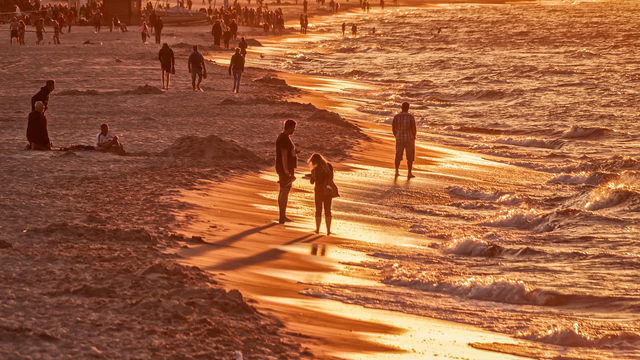
The sand along this coast is fine and pale, carried down over a very long time by the rivers that come out of the Alps. The beaches are wide and they shelve so gently that you can walk a long way out and still be standing in water to your waist. The swell is usually small. Much of the year the sea there is close to flat.
All of that means a ring that goes into the water or onto the sand tends to stay near where it fell. It does not get thrown along the coast by big waves overnight. It sinks a little into soft sand and waits.
What to do in the first few minutes
Stop walking, and ask the people with you to stop too. Every step pushes a ring in soft sand a little deeper and moves it a little further from where it was. Fine sand is especially bad for this, because it shifts easily under feet.
Mark the spot with something you can leave there, a towel or a bag. Then look back towards the land and pick two things you can line up with later. On the Lido that might be a particular row of the striped beach huts and a hotel behind them. At Jesolo, with its long straight beach, it helps to note the number of your umbrella row or the name of the bathing establishment, because every stretch looks much the same once you walk away. Grado has its breakwater and the old town, which give you good fixed points.
Take a photo facing the sea and another facing the land, from exactly where you are standing. Write down the time, too. If you lost it in the water, note how deep it was against your body.
Please do not dig, and do not let a crowd of helpful people sweep the sand with their hands and feet. Churned sand is the hardest ground to search. A ring sitting in untouched sand is far easier to pick out than one somewhere in a patch everyone has kicked over.
Where rings settle on this coast
Most rings on these beaches are not lost in the sea at all. They come off on the sand, near the umbrellas and sunbeds, while people put on sun cream or shake out towels. That dry sand is soft and gets walked on constantly, so a ring can sink quite quickly, sometimes deeper than people expect. It is still well within reach of a detector, and it is still close to where it went down, but a search there is slow because the sand is full of bottle caps and ring pulls. Every signal has to be checked.
In the water, the shallow shelf is your friend. A ring that slips off in knee deep or waist deep water off Jesolo usually lands on the bottom close to where you were standing, and in wet sand it tends to sit in the top 15 to 25 cm. The gentle slope means a searcher can cover the area properly, on foot, without needing to dive.
Two things complicate that a little. The first is the tide. The northern Adriatic has noticeably bigger tides than most of the Mediterranean, and at low water a strip of wet sand is uncovered that was under water a few hours before. That can help, because a ring lost in the shallows may be reachable on foot at low tide. It also means the water line you remember may not be where the water is when someone comes back to look, which is one more reason to note your fixed points on land and not the edge of the sea.
The second is the sandbars. Much of this coast has low bars running parallel to the beach, with slightly deeper water between them. People often wade out to the first bar, stand on it chatting, then come back through the trough. If that was you, try to remember whether the ring came off on the bar or on the way back. Those are different places to search, and it is useful to know which one.
Grado is shallower still, with lagoon on one side and very gentle sand on the other. It can be one of the easier places to search, but the lagoon side is soft mud in places, and a ring dropped into mud behaves differently from one dropped into sand. If you lost it on the lagoon side, say so.
Venice itself is a different matter. A ring dropped into a canal in the city, from a gondola or a water bus, is not a beach search. The water is deep and murky, and that is a job for a diver if it is possible at all. We would rather tell you that straight away.
Other things that go missing here
Rings are the usual story, but the same beaches take plenty of other things. Wedding bands and engagement rings come off in the water when hands get cold after a long swim. Smart rings such as an Oura are lost the same way, and they read on a detector because they are metal. Watches, earrings, chains and bracelets all turn up. So do phones and car keys dropped in the sand around the sunbeds.
Metal framed glasses and sunglasses show up on a detector. Plastic sunglasses do not, so those need a search by eye in clear water, which on this coast is sometimes possible on a calm morning.
If you have come across from the other side of the gulf, the rocky coast of Istria is a very different kind of search from the soft sand around Venice. Further south, the long sandy beaches of the Rimini Riviera behave much more like Jesolo, with the same wide shallow shelf and rows of umbrellas.
We do not have a detectorist based on this stretch of coast yet, so we cannot promise that someone will be there tomorrow. What we can do is look for a finder who can reach you, and the soft sand and shallow water here mean that a search started within a day or two has a fair chance. Our page on Venice Lido, Jesolo, Lignano and Grado has more about the beaches we cover.
Send us what you have through the get help form or on WhatsApp. Tell us which beach and roughly where on it, the time, whether you were on the sand or in the water, what the ring is made of and anything engraved inside it. Add your photos of the spot. We will look for someone who can search there and tell you honestly what we think the chances are before anything is arranged. We explain the costs before any search is booked.