Lost a ring off the rocks in the Marseille calanques
Lost a ring off the rocks at Sormiou, Morgiou or Port-Miou? How deep clear water changes the search, when you need a diver, and what to do first.
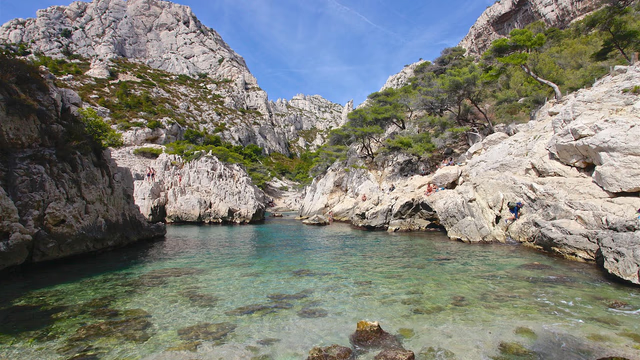
The calanques are some of the most beautiful places on the French coast to swim, and some of the hardest places to lose a ring. You jump off a warm white rock at Morgiou, or you climb out at Port-Miou with cold fingers, and a moment later you realise your wedding band is gone. The water looks so clear you feel you should be able to see it. Usually you cannot.
This is an honest guide to what happens next, and to the difference between a ring lost on the little beaches and one lost off the rocks.
What to do before you leave the rocks
Stay where you are for a minute and think about the exact moment. Were you in the water, climbing out, or sitting on the rock drying off? Those are three different searches, and the last one is by far the easiest. A ring that slips off while you are sitting on a flat ledge often ends up in a crack in the limestone or in the gravel at its base, a metre or two from where you sat.
Look along the rock first, slowly, in the cracks and pools. Use your phone torch even in daylight, because gold catches light in shade better than in sun. Do not put your hand into narrow gaps you cannot see into, and do not try to lever stones out.
Then fix the spot. On a rocky shore there is no umbrella row to count, so take photos. One facing the sea and one facing the cliff behind you, taken from the rock you were on. Note a landmark across the water too, such as a boat mooring or a point of the cliff, and write down the time. If the ring went into the water, try to remember how far out you were and roughly how deep it felt. Could you touch the bottom? Were you treading water?
If you are swimming or snorkelling with a mask, you can have a careful look at the bottom near the rocks while the water is calm. Do not dive deeper than you are comfortable with and do not start moving stones around. Divers and detectorists find a ring far more easily in ground nobody has disturbed.
Why deep clear water is a different job
At a sandy beach like the Prado or the Catalans, most rings are lost in shallow water or on the sand. A detectorist can wade in, sweep a grid and dig. That is a normal search, and our page on Marseille and Provence covers the city beaches in more detail.
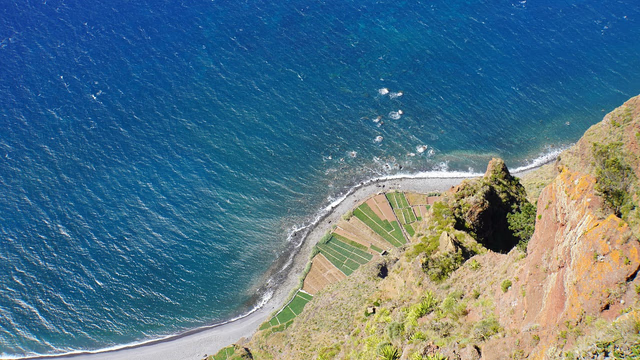
The calanques are different. The rock goes down steeply, and just a few metres from the edge the water can be deeper than you are tall. The bottom is often boulders with gravel pockets between them, sometimes with sand further out. A ring does not stay on top of that. It slides into the gaps between stones, or settles into the gravel where it cannot be seen at all.
That is where people get the wrong idea from the clear water. You can see the bottom, so it seems as if a ring should be visible. In practice a small band lying on its edge between two rocks is almost invisible from the surface, even to someone looking hard. What finds it is a detector held close to the bottom.
So the question becomes one of depth. As a rough guide, if the ring went down where you could stand, a detectorist wading with a waterproof machine can often search it on a calm day. Where it is deeper than that, it becomes a job for a diver working with an underwater detector. That is slower and takes more planning, but it is not hopeless. Rings lost off rocks are sometimes recovered precisely because they are wedged in one place and do not move with the waves the way they would on a beach.
The mistral matters as well. When it blows, the sea in the calanques can go from glassy to rough quickly, and nobody should be searching close to the rocks then. It also shifts gravel and sand in the shallower pockets. That is one reason why the sooner a search starts, the better. A ring lost on a calm evening is best looked for in the next calm spell, not the one after that.
Other things that go down off the rocks
Rings are the usual story, but the calanques take plenty of other things. Watches and smart rings like an Oura come off in the water when hands are cold. Earrings and thin chains drop when people pull a T-shirt over their head on the rocks. Car keys and phones fall out of pockets on the steep paths, or into the water from a kayak or a boat moored in the inlet.
All of those are metal and read on a detector. Metal framed glasses and sunglasses do too. Plastic sunglasses do not, so if you lost those, it is a search by eye, which in water as clear as this is sometimes possible for a diver or a good snorkeller.
If you have been moving along the coast, it is worth knowing how the next stretch differs. The beaches around Cassis and La Ciotat, covered on our Var coast page, mix small pebble coves with the same steep rocky edges. Further east, the Côte d’Azur has long pebble beaches that behave differently again.
We do not yet have a detectorist or diver we work with regularly around Marseille, so we cannot promise that someone will come out tomorrow. What we can do is look for a finder or a diver who can reach the calanque you were in, and tell you honestly whether we think it is worth trying.
Send us the details through the get help form or on WhatsApp. Tell us which calanque, whether you lost it on the rock or in the water, how deep you think it was, the time, and what the ring is made of, with anything engraved inside it. Add your photos of the spot. We will come back to you with what we can arrange, and we explain the costs before any search is booked.