Lost a ring on Madeira's pebble beaches, from Madalena do Mar to Calheta
Lost a ring on a Madeira beach? Why volcanic pebbles hide it, how the Atlantic swell changes things, and when a dive centre is the realistic route.
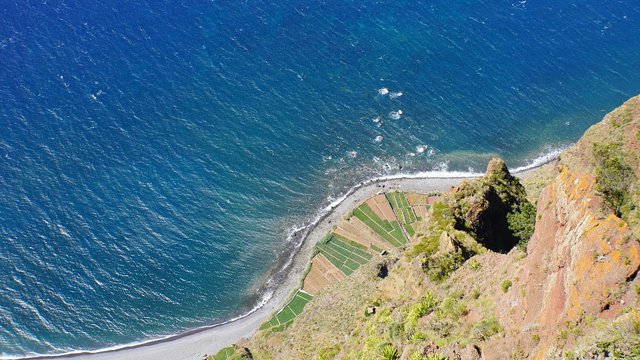
Madeira is a beautiful place to lose something small, and a difficult one. Most of the island’s beaches are made of dark, rounded volcanic pebbles rather than sand. The water gets deep very close to the shore. And the sea here is the open Atlantic, so the swell can change a beach from one day to the next.
If you have just lost a wedding band or a watch on a Madeira beach, start here. Stop moving stones around with your hands. Drop a pin on your phone where you were standing, write down the time, and take two photos, one looking out to sea and one looking back up the beach with something fixed in the frame, such as a set of steps or the end of a breakwater. On pebbles, knowing the spot to within a metre or two matters more than almost anything else.
Why pebbles hide a ring so well
On flat sand a dropped ring tends to lie on the surface or sink a little way. On pebbles it does something different. It slips down into the gaps between the stones, and every wave that washes over the beach shuffles those stones and lets it drop a bit further. A ring can end up well below the surface within a day, sitting in a pocket that looks exactly like every other pocket around it.
That is why hand searching usually makes things worse. You lift a few stones, the ones around them roll in, and the ring goes deeper or moves sideways. It feels like doing something useful, but on a pebble beach it rarely is.
A metal detector still works on volcanic pebbles, but it is slower going. Some volcanic rock carries iron minerals, which a detector can pick up as background noise, and the finder has to set the machine up to ignore it. Once a signal is found, the ring has to be lifted out by hand from between the stones, sometimes with a fair amount of digging. None of this rules a search out. It just means the marker you took on the day is worth a lot.
Madalena do Mar is a good example. The beach there mixes pebbles with black sand, and on the south coast it often gets calm water in summer. A ring lost high on the beach, in the dry stones near where people lay their towels, has a fair chance of staying close to where it fell. A ring lost at the water’s edge, where the waves are working the stones, is a harder case. Ponta do Sol, a little further east, is a small pebble beach in a cove, and the same thinking applies.
Calheta and the other sand beaches are kinder ground
Calheta is different. The beach there is golden sand brought over from Morocco, about 100 metres of it, protected by two breakwaters. Banda D’Além at Machico is the same idea, also imported golden sand. On a small, sheltered sand beach like these, a ring usually stays close to where it was dropped, and a detectorist can cover the whole thing properly. If you lost it at Calheta, tell us which end you were at and whether you were on the sand or in the water.
The breakwaters change things slightly. In calm conditions the water inside them is gentle, but when a swell comes in from the Atlantic, sand gets moved around inside the bay and a ring near the water line can be buried deeper. That is one reason the day and the time you lost it both matter. Madeira has two high tides and two low tides a day, and tide predictions for Funchal show you where the sea was at the moment it happened. Send us the time and we can check.
The coppery volcanic sand at Prainha, near Caniçal, is another softer option. Porto Santo has nine kilometres of golden sand, but that is a much bigger area, and without a precise marker a search there can be a long shot. We would rather tell you that honestly than pretend otherwise.
When a dive centre is the right call
A lot of swimming on Madeira happens off concrete and rock rather than beaches. The Lido and the other bathing complexes in Funchal, and the natural lava pools at Porto Moniz and Seixal, mean concrete decks and rock edges with deep water right beside them. If your ring went off a ladder or a rock ledge into water deeper than your waist, a detectorist walking the shore is not going to reach it.
That is a job for someone in the water with a mask. Madeira has several dive centres, many of them along the south coast around Funchal and Caniço, and some may look for lost items on a calm day if you ask. It is worth calling them directly and giving them the same pin, time and photos you would give us. In the lava pools at Porto Moniz, where the water is roughly two metres deep, an Oura ring or a watch can lodge in a crack in the rock, and a snorkeller with a torch and patience is often the best chance it has.
The same goes for things dropped off boats. Phones and sunglasses go overboard on whale and dolphin trips out of Funchal. A phone or metal-framed glasses can be found with a detector once someone is down there, but plastic sunglasses cannot, so they have to be spotted by eye.
A few other things help, whoever ends up searching. Tell the staff at the bathing complex or the beach bar before you leave, because jewellery does get handed in. Write down what the ring is made of. Yellow gold gives a clear signal, while white gold and platinum are quieter on a detector. If it is engraved, say so, as that helps prove it is yours if someone else picks it up first.
We should be plain about where we stand. We do not have a finder on Madeira right now, so we cannot promise that someone will come out to your beach. What we can do is take your details and try to find a detectorist or a diver who can reach that part of the island. The volcanic ground is similar on the Azores and on Tenerife, where black sand and rock shores cause the same problems, so the advice above works there too. We explain the costs before any search is booked, and if the odds look poor we will say that as well.
If you lost a ring or a watch anywhere on Madeira, send us your pin, the time and a photo of the item through the get help form or on WhatsApp, and we will start looking for someone who can search there.